 |
| snow day at our house... take shelter Melissa Frost |
Monday, February 11, 2013

Sunday, February 10, 2013
Powerful Image

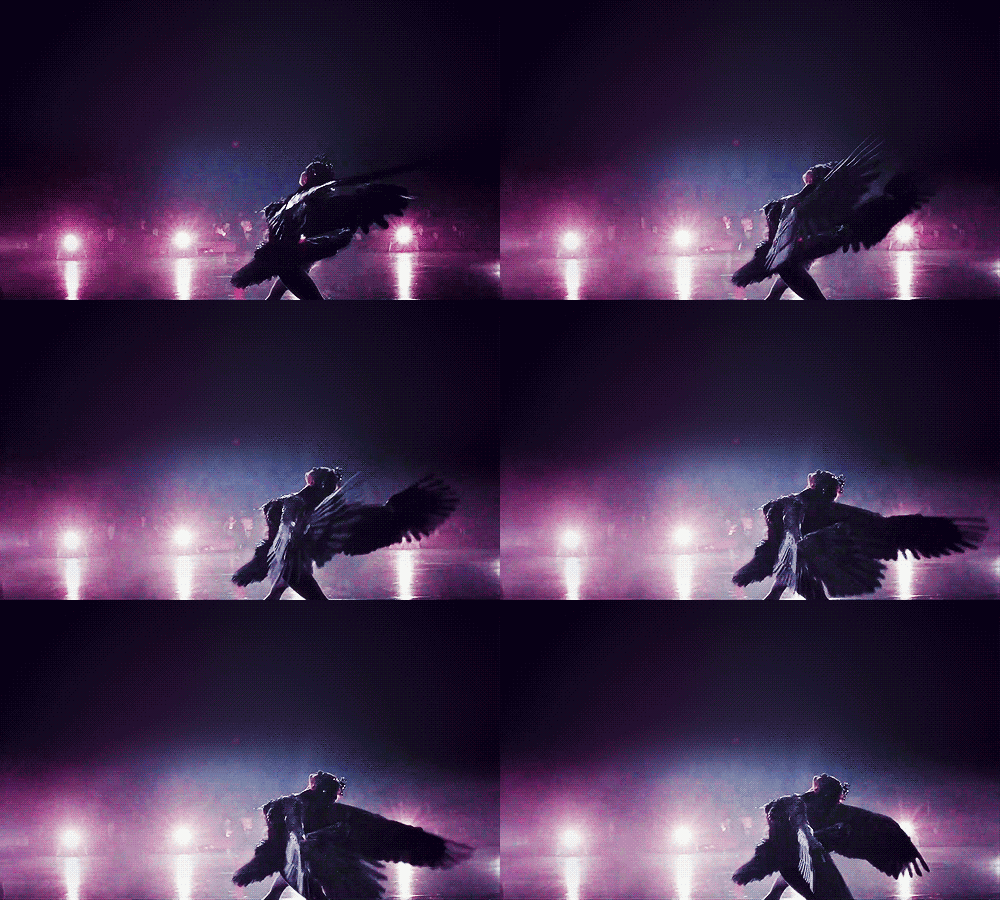
The image I have chosen is from the movie Black Swan, a psychological thriller which follows a ballerina named Nina competing for the position of prima ballerina in a production of Swan Lake.
As the principal dancer in this production, Nina is required to play both the role of the White Swan, which, as the picture of innocence she is perfectly suited for, and the Black Swan, a much darker role that she has trouble channeling. However, as time goes on and she becomes more and more consumed by the performance, she seems to embody the Black Swan more than the White. In this scene as Nina dances, her eyes burn red and black feathers begin to cover her body; her arms become her wings, and you can almost feel the darkness take her over.
I have always been drawn to dance, and images of dancers. They are simultaneously the personification of both grace and physical strength. They are able to convey emotion so beautifully without ever using words, only body language. I'm not sure that this image can truly convey the emotion that this dancer is exhibiting since it's not the best quality image (I apologize!), but I remember tearing up in the theater as she struck that final pose. Everything about it is beautiful: the way she is framed, the lighting, her bold and confident body language. The energy within her is so palpable, is seems that if you were to touch her, she'd explode.
I included a gif file below to give you a better idea of that final pose. (I don't really like gifs because they make me dizzy, but this was the closest I could find to a higher quality image.)
http://24.media.tumblr.com/tumblr_lvc3x84aHA1r2gjllo1_500.gif
-Jamie
Friday, February 8, 2013
Powerful Image
I selected images from the movie The Fall; the first is a high quality screen shot, and the second is a screen capture from my own computer. (I really prefer the second, but I was unsure if its quality really did it justice; I hope the first can inform the second a bit!)
To me, both communicate the vastness of the dessert in the shot. The main characters (whom the viewer has just interacted with, close-up) are like pinheads on the sand, and the bright oranges and blues of the hot, harsh environment are beautiful but menacing. These images do a great job of literally swallowing the main characters in the dessert.
This is very appropriate for the film, because a lot of its premise is focused on a paralyzed, bed-ridden man in the hospital explaining to a little girl (whose first language is not English) what happened to him. He does so by telling her a fictional story about a hero (himself, in disguise) and his journey for revenge and (unrequited) love. Seems like starting off in a dessert is a great way for this man to begin to explore and express his current state.
-Alicia


To me, both communicate the vastness of the dessert in the shot. The main characters (whom the viewer has just interacted with, close-up) are like pinheads on the sand, and the bright oranges and blues of the hot, harsh environment are beautiful but menacing. These images do a great job of literally swallowing the main characters in the dessert.
This is very appropriate for the film, because a lot of its premise is focused on a paralyzed, bed-ridden man in the hospital explaining to a little girl (whose first language is not English) what happened to him. He does so by telling her a fictional story about a hero (himself, in disguise) and his journey for revenge and (unrequited) love. Seems like starting off in a dessert is a great way for this man to begin to explore and express his current state.
-Alicia


Wednesday, February 6, 2013
Powerful Image - Kevin Carter's 'Child with a Vulture' photo

Kevin Carter’s Pulitzer Prize-winning photograph of a
starving Sudanese child with a vulture in the background, presumably waiting to
prey on the child, is a meaningful image to me.
Carter’s photo created awareness of the humanitarian crisis in the
famine-stricken nation, but the photographer was still criticized by many for failing
to help the child. To me, it’s
impossible to see this image without becoming Kevin Carter and wondering about
the ethical dilemma he was faced with.
This is the quintessential image of the debate over the code of ethics
in journalism. At what point do I put
down my camera and help an individual? Was
this little girl sacrificed for the “greater good” in an effort to show the
rest of the world what was happening in Sudan?
Didn’t Carter do the world a favor by creating such a powerful
image? Kevin Carter committed suicide
shortly after winning the Pulitzer Prize for this image. His suicide note indicated that the nature of
his work contributed largely to his depression.
-Krissie
Image:
http://en.wikipedia.org/wiki/File:Kevin-Carter-Child-Vulture-Sudan.jpg
For more info:
http://www.nytimes.com/1994/07/29/world/kevin-carter-a-pulitzer-winner-for-sudan-photo-is-dead-at-33.html
http://www.kevincarterfilm.com
http://en.wikipedia.org/wiki/Kevin_Carter
Monday, February 4, 2013
A mix of first week screenings
Our full class didn't meet last week..so this is our true "first week". here's a mix of our screenings we will be looking at, time permitting.
We will look at some work from the Media Matters film festival:
http://www.youtube.com/user/mediathatmatters
The main site for the festival is http://mediathatmattersfest.org/
From the web site:
Media That Matters is the premiere showcase for short films on the most important topics of the day. Local and global, online and in communities around the world, Media That Matters engages diverse audiences and inspires them to take action. From gay rights to global warming, the jury-selected collection represents the work of a diverse group of independent filmmakers, many of whom are under 21. The films are equally diverse in style and content, with documentaries, music videos, animations, experimental work and everything else in between. What all the films have in common is that they spark debate and action in 12 minutes or less.
Specifically, we will look at a film called "A Girl Like Me", directed by Kiri Davis, a teenager. This is about young African American women, hair, identity, and representation.
http://www.youtube.com/watch?v=YWyI77Yh1Gg
We will look at a short called "The Job". This is by Jonathan Browning, of Screaming Frog Productions. We will be looking at camera angles, social issues in the film, and how it comes together as a whole.
https://vimeo.com/32488410
We will also possibly be looking at some early work by Martha Rosler on semiotics, and some work by choreographer, artist and dancer Maya Deren.
We will talk about the uses of documentary and animation.
I don't think we'll get to it, but this is a documentary (in spanish) about Oscar Brahim, a street artist and taxi driver in Mexico City.
http://www.youtube.com/watch?v=_fBN396KzgE
At times we will intersect with some content on Ilana Boltvinik's syllabus, as we are doing an exchange with her class in Mexico City this spring:
http://tecnologiasarte.blogspot.com/
We will look at some work from the Media Matters film festival:
http://www.youtube.com/user/mediathatmatters
The main site for the festival is http://mediathatmattersfest.org/
From the web site:
Media That Matters is the premiere showcase for short films on the most important topics of the day. Local and global, online and in communities around the world, Media That Matters engages diverse audiences and inspires them to take action. From gay rights to global warming, the jury-selected collection represents the work of a diverse group of independent filmmakers, many of whom are under 21. The films are equally diverse in style and content, with documentaries, music videos, animations, experimental work and everything else in between. What all the films have in common is that they spark debate and action in 12 minutes or less.
Specifically, we will look at a film called "A Girl Like Me", directed by Kiri Davis, a teenager. This is about young African American women, hair, identity, and representation.
http://www.youtube.com/watch?v=YWyI77Yh1Gg
We will look at a short called "The Job". This is by Jonathan Browning, of Screaming Frog Productions. We will be looking at camera angles, social issues in the film, and how it comes together as a whole.
https://vimeo.com/32488410
We will also possibly be looking at some early work by Martha Rosler on semiotics, and some work by choreographer, artist and dancer Maya Deren.
We will talk about the uses of documentary and animation.
I don't think we'll get to it, but this is a documentary (in spanish) about Oscar Brahim, a street artist and taxi driver in Mexico City.
http://www.youtube.com/watch?v=_fBN396KzgE
At times we will intersect with some content on Ilana Boltvinik's syllabus, as we are doing an exchange with her class in Mexico City this spring:
http://tecnologiasarte.blogspot.com/
Wednesday, January 30, 2013
The Sleep Dealer

Sleep Dealer is a 2008 futuristic science fiction film directed by Alex Rivera. Sleep Dealer depicts a dystopian future to explore ways in which technology both oppresses and connects migrants. A fortified wall has ended illegal US-Mexico immigration, but migrant workers are replaced by robots, remotely controlled by the same class of would-be emigrants. Their life force is inevitably used up, and they are discarded without medical compensation.
http://en.wikipedia.org/wiki/Sleep_Dealer
An interview with Alex Rivera in the online magazine Crossed Genres is here:
http://crossedgenres.com/archives/024-charactersofcolor/interview-alex-rivera/
Rivera's description (from the interview) of how he got to be interested in these themes is here:
I grew up in up-state New York in a house that was connected, primarily by technology, to Latin America. The connection that I had through my father to Peru was mediated largely by the television, the telephone, and home videos which were exchanged. I knew that I had Peruvian blood and Peruvian family, but my experience of that other place was very mediated.
One of his first films is more experimental in nature..a short (around 20 minutes) called PapaPapá
http://www.invisibleamerica.com/qt-150-papapapa.html
In class one of the things we talked about was how visceral it felt (and painful) to see the connections (or nodes) that were placed in the bodies of the workers. I talked a little about cybernetics, and the idea of the awkward interface between the human body and machine.
http://en.wikipedia.org/wiki/Cybernetics
For a feminist take on cybernetics, read Donna Haraway's
A Cyborg Manifesto: Science, Technology, and Socialist-Feminism in the Late Twentieth Century
http://www9.georgetown.edu/faculty/irvinem/theory/Haraway-CyborgManifesto.html
-ss
Wednesday, January 16, 2013
She chuckles..even at your bad jokes.
One of my students in my art and culture in community class gave me this link from Men's Health magazine December 9, 2012. It is an image based on some information they collected about the anatomy of the "perfect woman". Here's how they conducted their research. I bolded the part that is particularly vague.
The formula for the perfect woman is pretty simple on the surface, right? Hot + smart + funny = The One. Yet it seems like every day, we find a new study that reveals another new thing men find alluring about women.
The latest news: According to data in the Journal of Sex Research, men are more pleased with their relationships and sex lives when their partners are 2 to 4 years younger than they are.
So it turns out that simple formula above is way more complex than we thought. That’s why we rounded up all the relevant research we could find to create the definitive blueprint for your dream girl. Starting with fewer candles on her birthday cake—#2 on our poster model below—here’s the anatomy of the perfect woman:
I'm not going to repost the picture, I really don't feel like perpetuating it, I will just post the link.
http://news.menshealth.com/the-perfect-woman/2012/12/09/
that image, however is in BAD need of remixing! If you remix it, send it to me and I will post it on this blog.
-sam smiley
The formula for the perfect woman is pretty simple on the surface, right? Hot + smart + funny = The One. Yet it seems like every day, we find a new study that reveals another new thing men find alluring about women.
The latest news: According to data in the Journal of Sex Research, men are more pleased with their relationships and sex lives when their partners are 2 to 4 years younger than they are.
So it turns out that simple formula above is way more complex than we thought. That’s why we rounded up all the relevant research we could find to create the definitive blueprint for your dream girl. Starting with fewer candles on her birthday cake—#2 on our poster model below—here’s the anatomy of the perfect woman:
I'm not going to repost the picture, I really don't feel like perpetuating it, I will just post the link.
http://news.menshealth.com/the-perfect-woman/2012/12/09/
that image, however is in BAD need of remixing! If you remix it, send it to me and I will post it on this blog.
-sam smiley
Subscribe to:
Posts (Atom)